
Curls are architecture, not a problem to fix
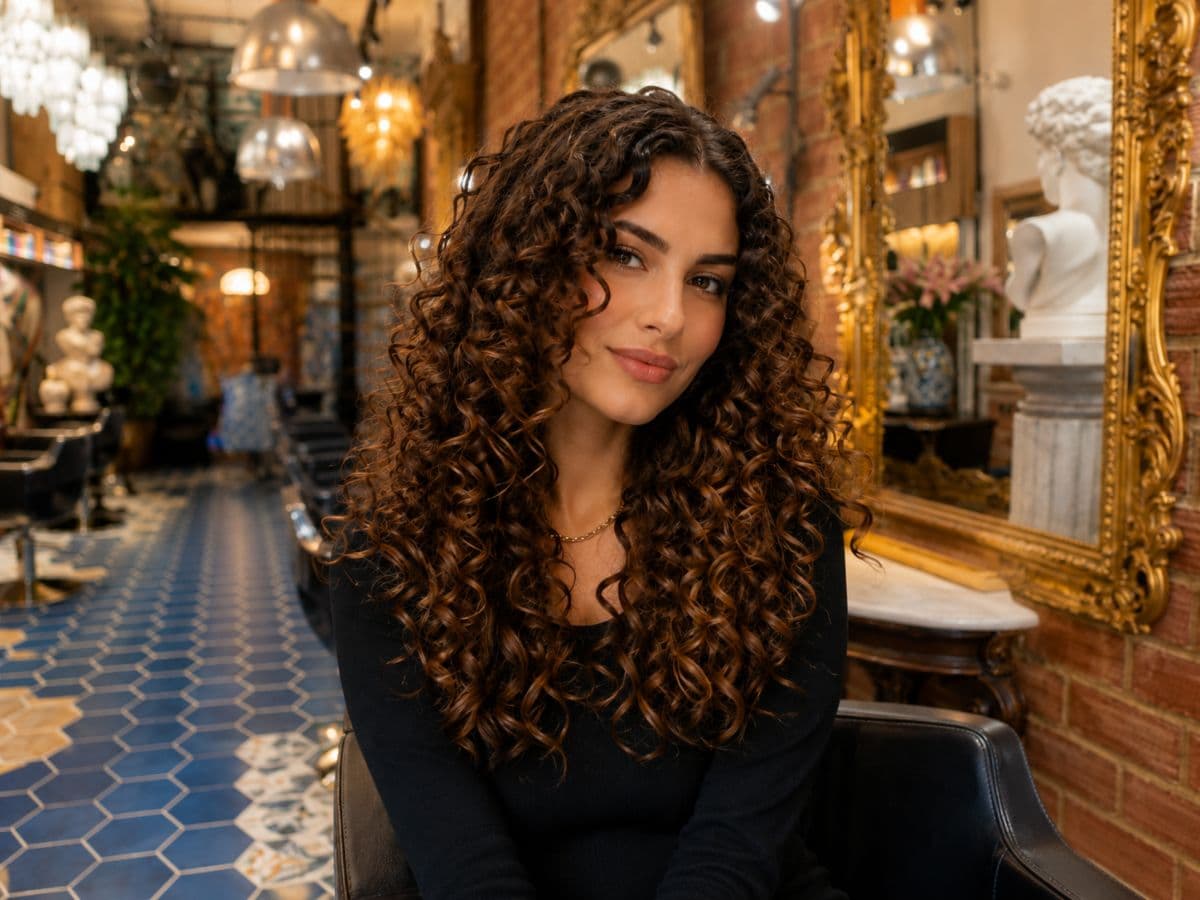
I spend most of my time thinking about texture. It's the whole job of designing this salon, gold leaf against raw brick, velvet next to industrial steel, nothing allowed to sit flat or predictable in the room. So it drives me a little mad when someone sits down in the chair with hair that's genuinely one of the most interesting textures a person can have, and years of straighteners have flattened it into something that photographs like everyone else's. That's why our curly hair consultations here in Torremolinos always start with texture, not with a generic product routine.
Curls are architecture. They catch light differently at every angle, the way a good staircase does. Somewhere along the way, a lot of people got told the opposite, that curls were a problem to solve rather than a feature to work with. I don't buy that, and neither does Goa Organics, the brand this whole method is really built on. Their founder started exactly where a lot of our clients start, curly hair with no definition, frizzy, breaking, exhausting to live with. That's not a coincidence I mention lightly. It's why curly hair care gets real attention here rather than sitting quietly behind straight cuts and colour on the price list.
Here's what most generic curly hair guides get wrong, and it's the same mistake a lazy interior designer makes. They treat every space the same way. A loose, fine 2A wave and a tight, dense 4C coil need completely different routines, completely different products, completely different handling, even though both get filed under the same tired label of “curly hair care.” And Torremolinos adds a variable almost nobody writing these guides ever accounts for: the humidity right here on this stretch of coast, which changes the whole equation.
So this isn't a copy of the Curly Girl Method you've already read a dozen times. It's what actually holds up here in Torremolinos, with the products we put our hands on every single day.
At Qué Bárbaro, the Curly Method service starts from 69€ and includes a curl focused approach to cutting, cleansing, hydration, definition, and drying, not a generic wash and go.
Why curly hair needs a different approach
Curly and wavy hair isn't damaged straight hair. It's structurally different. The hair shaft itself bends and twists as it grows, which means the natural oils your scalp produces have a much harder time travelling down the length of the hair the way they do on straight strands. That's why curly hair tends to be drier, more prone to frizz, and more fragile at the ends, even when it's perfectly healthy.
Most of the damage we see isn't from having curly hair. It's from decades of being told to fight it. Straighteners, harsh brushing, shampoos built for straight hair that strip away the moisture curls depend on. The Curly Method exists to undo that, not by adding more products, but by removing the habits that were never right for this hair type in the first place.
Understanding your curl pattern
Not all curls behave the same way, and treating a 2B wave the same as a 4A coil is one of the most common reasons people feel like the method “isn't working” for them.
Type 2, waves
Loose, S-shaped waves that range from fine to thick and are often prone to frizz rather than true curl collapse. This type generally needs lightweight hydration and gentle definition, since heavier products can weigh the wave pattern flat instead of enhancing it.
Type 3, curls
Springy, well-defined spirals, from loose loops to tight ringlets. This is the type most people picture when they think “curly hair,” and it usually responds very well to a full wash and definition routine.
Type 4, coils
Tightly coiled, fluffy, full of volume and shrinkage. This texture needs the most moisture of the three, along with real slip during detangling, since coils are the most fragile pattern and the most prone to breakage under harsh handling.
Most heads aren't a single type all over. It's completely normal to have 3A curls at the crown and looser 2C waves underneath, and that's exactly why a proper curly hair consultation in Torremolinos matters more than following a generic online routine, whether you live here in Torremolinos, come down from Málaga, or you're visiting from Benalmádena or Fuengirola for the day.
Many of our English speaking curly hair clients come from Torremolinos, Málaga, Benalmádena and Fuengirola for exactly this reason. They're not looking for a generic blow dry, they're looking for someone who actually understands curl pattern, porosity, and humidity.
Why porosity matters as much as curl type
This is the part almost every online guide skips entirely, and it's often the actual reason a curly routine fails. Porosity describes how easily your hair absorbs and holds onto moisture, and it depends on the condition of the outer cuticle layer.
Low porosity hair has a tightly sealed cuticle, product tends to sit on top rather than absorb, so lightweight, water based formulas work best. High porosity hair, often from colour treatment, heat damage, or the natural curl structure itself, absorbs moisture quickly but loses it just as fast, so it needs richer, oil sealed formulas to actually hold onto that hydration. Using the wrong weight of product for your porosity is one of the most common reasons the same routine works beautifully for one curly friend and does nothing for another.
Is the Curly Method right for your hair?
Natural, untreated curls
This is the most straightforward case. If your curls have never been chemically treated, the method usually shows results within two to three weeks of consistent use, sometimes faster.
Colour treated or highlighted curly hair
Colour changes the hair's porosity, almost always pushing it higher, since lightening opens the cuticle. This isn't a reason to avoid colour, but it does mean the routine needs adjusting, usually toward richer masks and more consistent protein and moisture balance, or the curls can start to feel gummy or stretched out rather than bouncy.
Fine, fragile, or thinning curly hair
Fine curly hair is a genuinely different challenge from thick curly hair, and it's the one place where heavier, richer products from either the Tasmania or Eternal Curls lines can actually work against you. In these cases we usually build a lighter routine, leaning on the shampoo and a small amount of gel or mousse rather than heavy masks and creams, so curls stay defined without going flat under the weight of product.
Curly hair on men
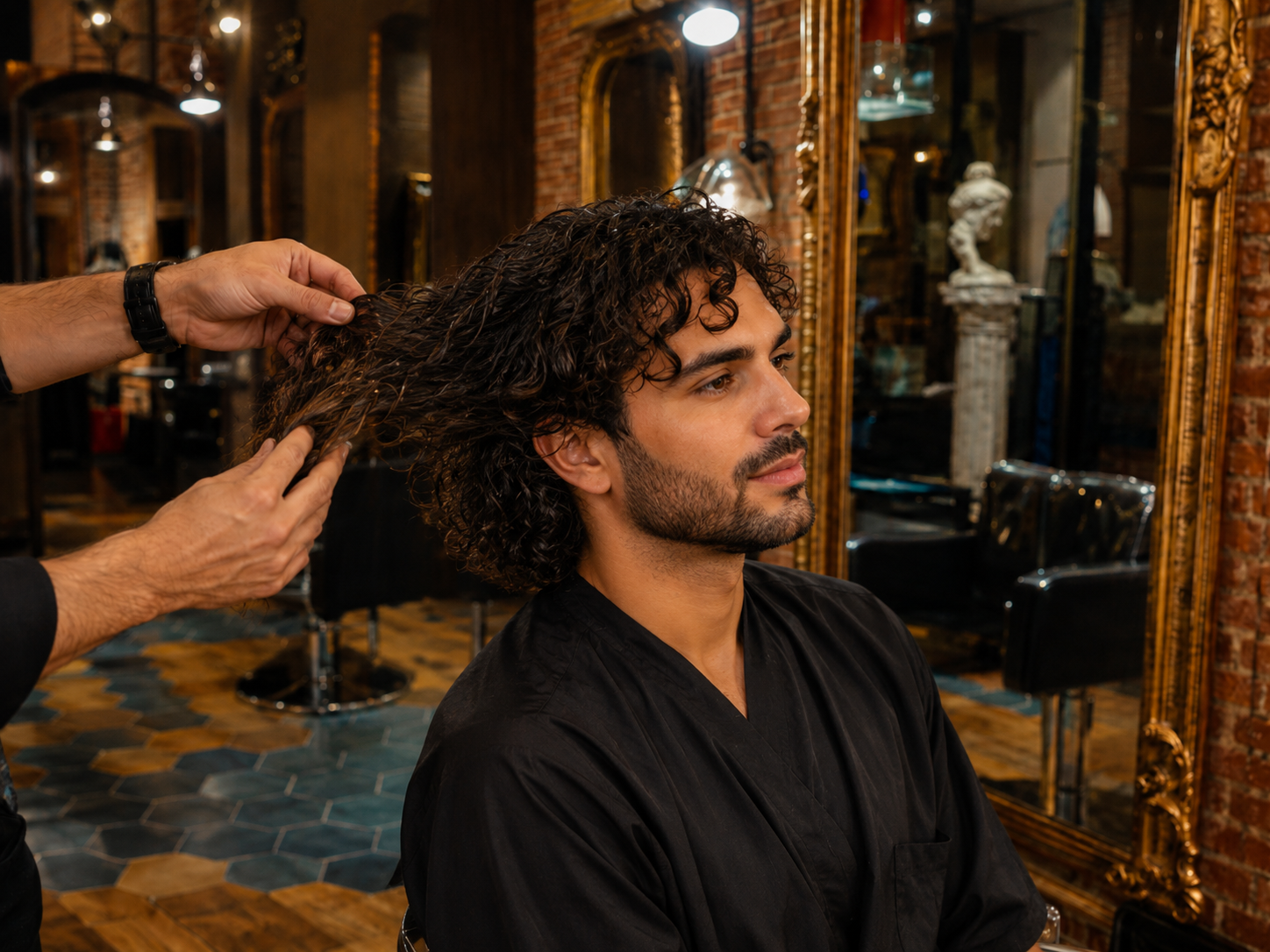
Curly and wavy hair is just as common on men as women, and the method works exactly the same way, though the styling goal is usually different, more texture and volume at the crown, tighter and cleaner at the sides. A good curly cut for men should be done dry or on damp hair rather than wet, since curls shrink significantly as they dry and a cut done on stretched wet hair can end up far shorter than intended once it springs back.
The consultation: what we actually check before starting
This is the step that separates a real curly hair service from someone just applying a product and hoping for the best. It's part of the same hair advice and consultancy service we use for colour clients, adapted for curl specific diagnosis.
Curl pattern mapping
We look at how the pattern changes across your head, since most people have more than one curl type, and the routine needs to account for that rather than treating the whole head identically.
A porosity check
A simple, quick assessment of how your hair is currently absorbing and holding moisture, which tells us whether to lean toward lighter, water based products or richer, oil sealed ones.
Scalp condition
Curly hair routines sometimes overcorrect on avoiding sulfates to the point that buildup accumulates at the scalp, which can quietly slow growth and cause irritation. We check for this specifically, since it's easy to miss at home.
History and current damage
Heat styling, chemical straightening in the past, colour treatment, all of it changes what your curls need right now, even if it happened years ago.
The Curly Method service, step by step
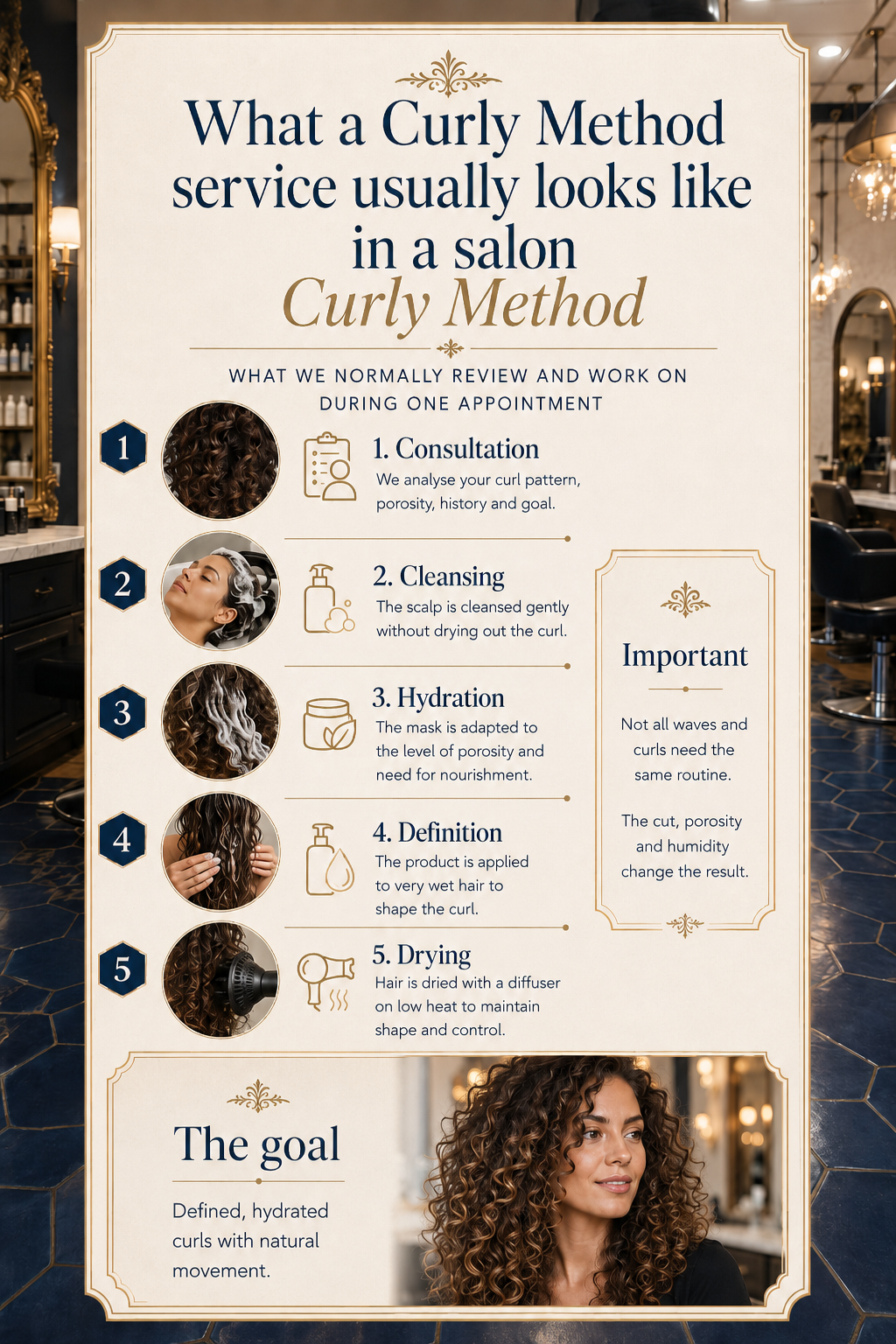
Our Curly Method service starts at 69€, and that covers the full process below, not just a cut. Here's exactly what's included.
Step 1, the cut
A proper curly cut is done dry or on damp, unstretched hair so we can actually see the finished curl shape as we cut, not a stretched out version of it. This is one of the most common mistakes from a standard wet cut on curly hair, and it's usually the reason someone leaves a salon with curls that look uneven or far shorter than expected.
Step 2, the cleanse
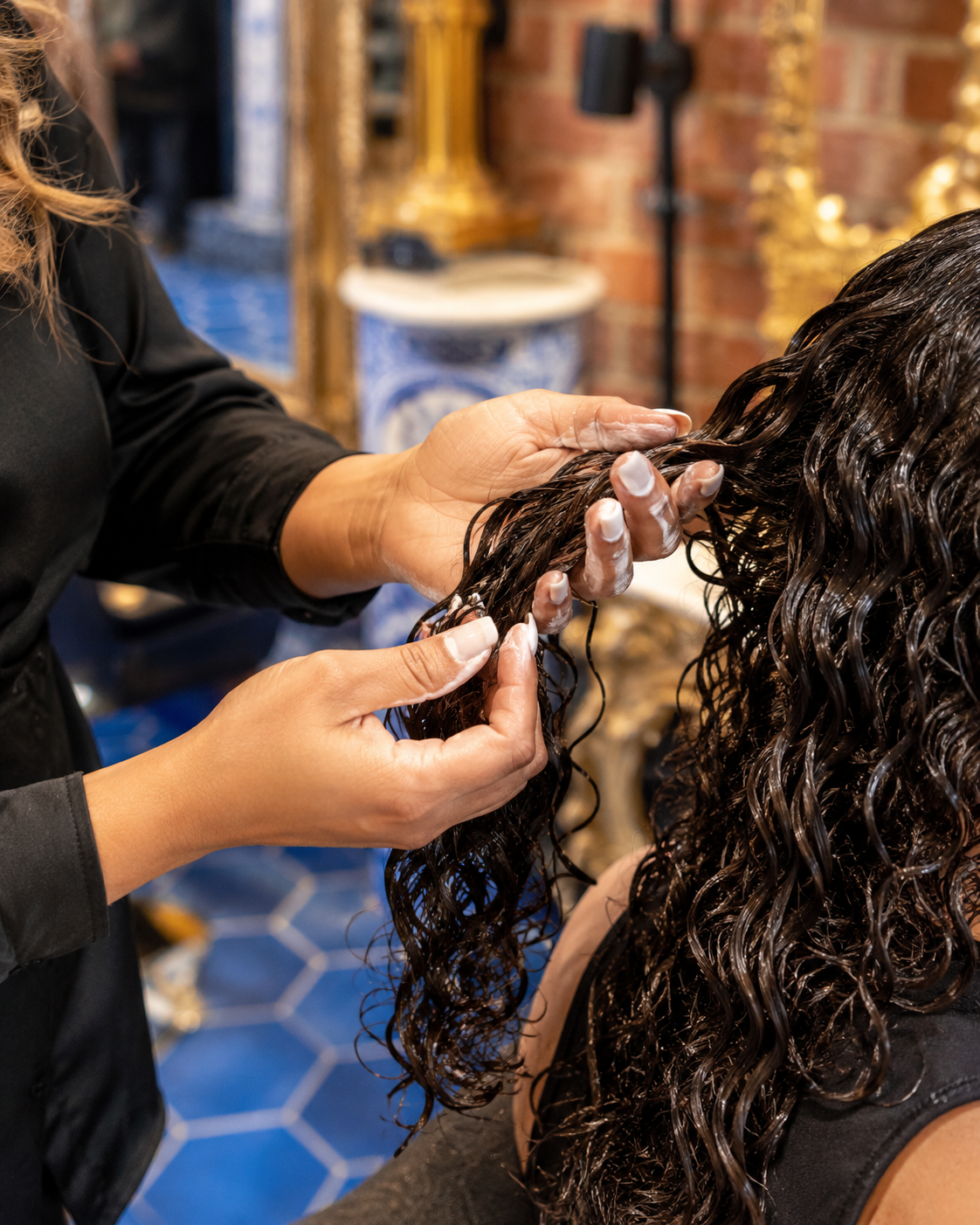
We use Tasmania Shampoo, which is enriched with açaí, banana, and cocoa extract, gently cleansing without stripping the natural oils curls depend on. It's built specifically to be compatible with the Curly Method philosophy, cleansing the scalp properly while leaving moisture and definition intact rather than resetting the hair back to dry and frizzy.
Step 3, deep hydration
Depending on your porosity, we'll use either the Tasmania Mask, formulated with mango, avocado, and tucumã oil to nourish without weighing hair down, or lean toward the Oribe Eternal Curls Deep Treatment Masque for hair that needs a richer, more intensive result, particularly on colour treated or high porosity curls.
Step 4, definition and styling
This is where technique matters as much as product. We apply styling product to hair that's still very wet, using either Tasmania Loop, a creamy curl activator built with jojoba oil, rice protein, and coconut oil, or a product from the Oribe Eternal Curls styling range depending on your curl type and desired hold. We use the scrunch technique, working from the ends up, and never brush through dry curls afterward.
Step 5, drying
A diffuser on low heat, never a direct high heat blast, which breaks down curl formation and adds frizz rather than removing it. For very fine or fragile textures, we'll sometimes recommend air drying entirely.
Why curly hair needs a different approach here in Torremolinos
This is genuinely the biggest variable curly hair guides written anywhere else simply don't account for. Torremolinos sits right on the coast, and the humidity here changes how curly hair behaves in a way that inland or drier climate advice just doesn't cover.
What humidity actually does to curls
Curly hair is naturally more porous than straight hair, and in humid air, that porosity works against you. The hair absorbs moisture from the air itself, not just from your products, which causes the strand to swell and the cuticle to lift, breaking down whatever curl definition you achieved after styling. That's the frizz you're seeing, it's not a failure of technique, it's simple chemistry.
Salt air and beach days
Salt water dries the hair further even while the surrounding air stays humid, which is a strange combination. Whether you're at the beach here in Torremolinos, over in Benalmádena, or down the coast in Fuengirola, you end up needing both anti humidity protection and extra hydration at the same time, which is exactly why a one size fits all product doesn't hold up well here.
The best treatment for frizzy curly hair here
This is where the Oribe Eternal Curls line earns its price point. It's genuinely built to handle exactly this problem, tested to protect hair from high humidity for up to 72 hours and reduce frizz by 79 percent in clinical testing. For a beach town where you might be in and out of salt water and humid air multiple times a week, that kind of humidity resistance isn't a luxury, it's the actual difference between curls that hold their shape through a weekend and curls that give up by lunchtime.
A humidity resistant finishing product, whether that's an Oribe Eternal Curls styler or a light sealing product, should be the last step of your routine on any day you're spending real time outdoors here, not an optional extra. In salon, we sometimes build this straight into the appointment through our Oribe Luxury Experience treatment, which is formulated specifically for curl control alongside repair and strengthening.
A routine built for a dry climate will not survive a Torremolinos summer. If your curls have been giving up by lunchtime, that's worth fixing before the humidity peaks, not after.
Message us on WhatsAppGetting to know the products we actually use
We don't just stock these lines because they're well known brands. We use them because they're formulated specifically around the two things curly hair actually needs, moisture and definition without weight, and because between the two of them we can cover almost any curl pattern, porosity, or budget that walks through the door.
Goa Organics Tasmania
Tasmania is Goa Organics' dedicated line for curly and wavy hair, part of their Curly Girls routine, built as a three step system.
Tasmania Shampoo is enriched with açaí, banana, and cocoa extract. It cleanses gently without stripping natural oils, and with consistent use, curls tend to look more defined, softer, and fuller.
Tasmania Mask is the deep hydration step, formulated with mango, avocado, and tucumã oil alongside glycerin. It's genuinely ultra hydrating without weighing hair down, which matters a lot for finer curl types that go flat easily under richer masks. Goa Organics recommends using it two to three times a week specifically for curly hair.
Tasmania Loop is the curl activator and final styling step, built around jojoba oil, rice protein, and coconut oil. Its creamy formula defines curls and controls frizz without leaving hair stiff or crunchy, which is the single biggest complaint people have with cheaper curl activating gels.
The whole line carries a light citrus fragrance, mandarin, bergamot, and Sicilian lemon, with a soft floral finish of jasmine and rose, and like the rest of the Goa Organics range, it's formulated without sulfates, parabens, or silicones, packaged in recyclable, sugarcane derived materials rather than conventional plastic.
Oribe Eternal Curls
Oribe's Eternal Curls collection, previously known as Moisture & Control, was reformulated and expanded specifically for curl patterns ranging from soft type 2 waves through tight type 4 coils. It's the line we reach for when hair needs more intensive hydration than a lighter routine can provide, particularly on colour treated, high porosity, or very coarse curls.
The collection includes a moisturizing shampoo and intense conditioner, a deep treatment masque for weekly intensive repair, and styling products including a curl gloss for shine and hold and a curl shaping mousse for lighter volume without heaviness. The newest addition, Polish and Protect Oil, seals and smooths without weighing curls down, which is particularly useful as a finishing step before you leave the salon or head out for the day.
What makes this line especially relevant here is the humidity performance we mentioned above, up to 72 hours of protection and a 79 percent reduction in frizz in clinical testing. That's not marketing language we're repeating, it's the actual reason we recommend it specifically for clients who spend real time at the beach or pool during the summer months.
The full lineup also includes a Priming Lotion, a leave in conditioning detangler used straight after the shower to prep hair before styling product goes on, and a Curl Shaping Mousse for anyone who wants lighter volume and hold without the heaviness of a cream. Oribe classifies the whole collection by curl pattern, from soft type 2 waves through type 3 springy curls to type 4 coils, so what we reach for on a loose beachy wave is genuinely different from what we'd use on a tight, dense coil, even within the same product line.
Which one is right for you
As a general starting point, finer or lower porosity curls tend to do better with Tasmania's lighter formulations, while thicker, more colour treated, or higher porosity curls often need the more intensive hydration Eternal Curls provides. But this genuinely varies person to person, which is exactly why we don't hand out a generic recommendation, we look at your actual hair during the consultation and build from there.
Maintaining your curls between salon visits
How often to actually wash
Curly hair generally doesn't need daily washing, and washing too often is one of the fastest ways to strip the moisture the method depends on. Two to three washes a week is a reasonable starting point for most curl types, though finer or lower porosity hair can sometimes go longer between washes than thicker, coarser textures.
Co-washing, and when it helps
Co-washing means cleansing with conditioner instead of shampoo, and it can work well for drier, more fragile curl types that don't produce much scalp oil. It's not right for everyone though, oilier scalps and product heavy routines still need a proper shampoo cleanse regularly, or buildup accumulates and starts to weigh curls down over time.
Refreshing curls between wash days
A light mist of water combined with a small amount of your styling cream or Tasmania Loop can revive second or third day curls without a full rewash. Work it through in sections rather than all over at once, so definition stays even rather than patchy.
Protecting curls overnight
Cotton pillowcases create friction that curly hair is especially prone to catching on, which leads to frizz and breakage overnight. A satin or silk pillowcase, or loosely wrapping hair before bed, makes a real difference to how curls look the next morning without any extra product.
Trims matter more than people expect
Split ends travel up the hair shaft faster on curly hair than on straight hair, since the twists in the strand make it easier for damage to spread. A trim every three to four months, even just a light one, keeps the overall shape and curl definition looking intentional rather than gradually more frayed.
Curly hair inspiration, and why a photo still isn't a formula
Curly hair references work a little differently than straight hair colour references, since curl pattern is largely genetic rather than something a product alone can fully recreate. Still, references help clarify what someone's actually chasing.
Soft, defined waves
Think the loose, effortless 2B to 2C texture often associated with beachy, low maintenance styling, wash and go with minimal product. If this is your goal but your natural texture runs looser or frizzier, the answer is usually technique and lightweight product, not more product.
Voluminous spiral curls
The bouncy, springy 3A to 3B texture that photographs beautifully but is genuinely one of the more demanding patterns to maintain consistently, since it's prone to both dryness and frizz simultaneously.
Tight, sculptural coils
4A to 4C texture needs the most moisture of any curl type and benefits enormously from protective styling between wash days, since this pattern is the most fragile under daily manipulation.
Whatever the reference, the honest answer is the same one we give with colour. We're not copying a photo, we're working with the curl pattern, porosity, and condition of the hair actually in front of us.
Common mistakes with curly hair care
Brushing dry curls
This is probably the single most common mistake we see. Brushing dry breaks up curl clumps and creates frizz almost instantly. Detangling should only happen on wet hair with conditioner applied, using fingers or a wide toothed comb.
Applying product to half dry hair
Styling products need to go on soaking wet hair to distribute evenly and lock in the curl shape properly. Applying to hair that's already partly dry means uneven definition and product sitting on top of the hair rather than working with it.
Overloading fine curls with heavy product
More product isn't more definition, past a certain point it's just weight, and weight flattens curl pattern rather than enhancing it. This is especially true for finer 2A and 2B textures.
Skipping the porosity conversation entirely
Following a routine built for someone else's porosity is one of the fastest ways to feel like the Curly Method “doesn't work,” when really the product weight was simply wrong for your hair.
Ignoring humidity protection here specifically
A routine that works perfectly in a dry climate can fall apart within an hour on a humid Torremolinos afternoon without a humidity resistant sealing step. This is the mistake we correct most often with clients who moved here or are visiting from drier regions.
Read what actual clients say about their results on our verified Google reviews before you book.
Book Your Appointment, From 69€
Built for Torremolinos Humidity, Not Just Photos
Book your curl consultation at Qué Bárbaro before the summer humidity peaks, and choose whichever channel suits you best. WhatsApp for an instant reply, or book online through Treatwell or Booksy depending on your availability.
Avenida Joan Miró, 15, Torremolinos · Get directions
Qué Bárbaro is on Avenida Joan Miró, 15, in Torremolinos, right in the heart of the Costa del Sol, inside what used to be an old mechanical workshop and is now, quite literally, a museum of beauty. You can learn more about the salon and our team, or see real examples of our work in the gallery.
Our curly hair services are guided by Aurelio Tabares, co-founder, COO, and GOA Organics specialist at Qué Bárbaro. As an interior designer by training and the creative heart of the salon, Aurelio brings the same attention to detail to curl consultations that he brings to every corner of the space itself.
FAQs about curly hair care
Does the Curly Method actually work in a humid climate like Torremolinos?
Yes, but it needs a humidity resistant finishing step that most generic guides don't mention. Products like the Oribe Eternal Curls range are specifically tested for humidity protection, which matters far more here than in a drier climate.
How long before I see results from the Curly Method?
Most natural, untreated curls show real improvement within two to three weeks of consistent use. Colour treated or previously damaged curls can take longer, since the hair's porosity needs to stabilise first.
Can I do the Curly Method with fine hair?
Yes, but the product weight matters more than usual. Fine curls need lighter formulas and smaller amounts of product than thicker or coarser curl types, or they'll fall flat under the weight.
Is the Curly Method suitable for men?
Yes. The hair care routine is the same, though the cut and styling goals are usually different, with more volume and texture at the crown and a cleaner finish at the sides.
What's the difference between Goa Organics Tasmania and Oribe Eternal Curls?
Both are built for curly and wavy hair, but Tasmania tends to suit finer or lower porosity curls better with its lighter formulations, while Eternal Curls offers more intensive hydration suited to thicker, colour treated, or higher porosity curls, along with clinically tested humidity protection.
Why does my curly hair look great right after washing but frizz out by afternoon?
That's usually humidity absorption, especially here in Torremolinos. The hair takes on moisture from the air itself, which lifts the cuticle and breaks down curl definition. A humidity resistant sealing product as your final step helps prevent this.
What is the best treatment for frizzy curly hair?
There isn't one universal treatment, since it depends on your curl pattern and porosity, but the combination that works most reliably is a gentle cleanse, a hydrating mask matched to your porosity, a curl defining product applied to soaking wet hair, and a humidity resistant sealer as the final step. That last step is the one most frizzy curly hair treatments skip, and it's the one that matters most here.
Where can I get a curly hair consultation in Torremolinos?
Right here. Book your curl consultation at Qué Bárbaro Hair & Care Salon, at Avenida Joan Miró, 15, Torremolinos. We'll map your curl pattern, check your porosity, and build a routine around your actual hair rather than a generic one.
This article was updated on 14 July 2026 with new sections on curl porosity, humidity specific care, and detailed product information.